
I started designing Eigent around one year ago, with a simple but ambitious question in mind: what should a desktop AI agent look like if it is built for real business work, not only for personal productivity?
At that time, the idea of a desktop AI agent was still relatively new. But recently, as products like Codex and Claude Cowork have appeared, I started hearing the same question more often:
“What is the difference between Eigent and these other agent products?”
On the surface, these products can look similar. They all allow users to give tasks to an AI agent. They all support workflows, tools, integrations, and some form of automation. They all try to help people get work done faster.
But from a design perspective, they are actually built from very different starting points.
The biggest difference is not only what the agent can do. It is who the product is designed for first.
Codex starts from the individual power user. Claude Cowork starts from the individual knowledge worker. Eigent starts from the organization.
That difference changes almost every design decision.
Three products, three starting points
Codex
- Designed for
- Technical power users
- Prepared by
- The individual operator
- Optimizes for
- Precision and control
Claude Cowork
- Designed for
- Knowledge workers
- Prepared by
- The individual delegator
- Optimizes for
- Accessible delegation
Eigent
Organization-first- Designed for
- Teams and organizations
- Prepared by
- Administrators and operators
- Optimizes for
- Governance and repeatability
Same Agent Category, Different Starting Point
When people compare AI agent products, they often compare features first:
- Can it write code?
- Can it use tools?
- Can it work with files?
- Can it automate workflows?
- Can it connect to external systems?
These questions are important, but they are not enough.
For me, the deeper design question is:
Who is expected to configure the agent before it starts working?
This question reveals the real difference between Codex, Claude Cowork, and Eigent.
Codex assumes the user is comfortable setting up the working environment. The user chooses the project, model, approval mode, tools, plugins, and workflow.
Claude Cowork assumes the user wants to delegate work in a more natural and approachable way. It hides more technical complexity and focuses on making AI feel like a personal coworker.
Eigent assumes something different: in many companies, the person using the agent should not be the person configuring the whole agent system.
In a real organization, models, tools, permissions, integrations, memory, security policies, and workflow rules often need to be prepared by administrators, IT teams, department leads, or internal AI platform teams.
So Eigent is designed around this idea:
The organization configures the agent environment. The employee uses it to complete business tasks.
Codex: Designed for the Individual Power User
Codex is a strong example of an agent product designed for technical or tool-confident users.
Its core user is usually someone who understands projects, repositories, local folders, development environments, model choices, approval policies, plugins, and automations.
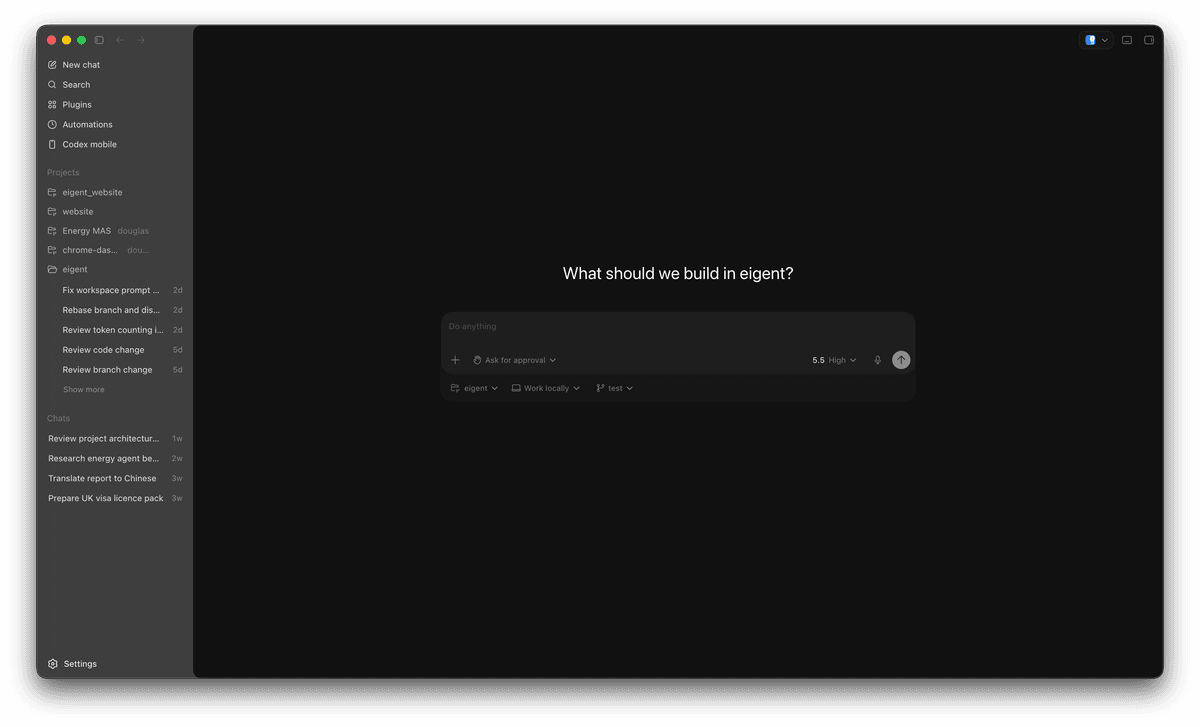
This makes Codex very powerful for people who want direct control.
A Codex user may decide:
- which project or repository to work on
- which model or reasoning level to use
- how much autonomy the agent should have
- which tools or extensions are available
- when the agent needs approval
This design works especially well for developers, technical teams, researchers, operators, and other power users who want precision and control.
The product logic is mostly bottom-up:
An individual discovers value, uses it across projects, shares habits with a team, and then the organization adds governance later.
This is a very natural adoption path for developer tools. Many successful technical products started this way. First, one user finds it useful. Then a team adopts it. Later, the company standardizes it.
So the design philosophy behind Codex can be summarized as:
Give capable individuals a powerful agent they can personally configure and supervise.
Claude Cowork: Designed for the Individual Knowledge Worker
Claude Cowork takes a different approach. It is still centered around the individual user, but it speaks to a broader group of professionals.
Instead of emphasizing infrastructure, Claude Cowork uses more familiar work language. It focuses on ideas like taking something off your list, working in a project, creating an artifact, scheduling a task, or delegating work to Claude.
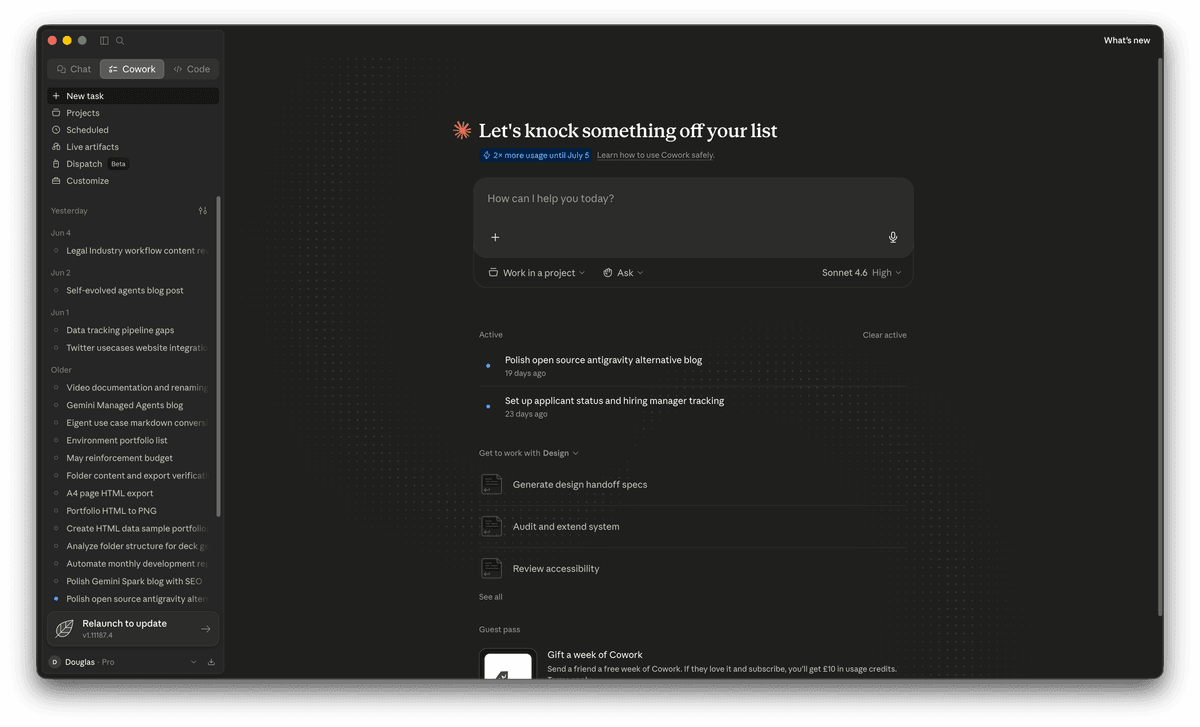
This makes the product feel more approachable for writers, designers, analysts, marketers, operators, and other knowledge workers who may not want to think about technical setup.
The mode structure also makes the product easier to understand:
- Chat is for conversation
- Cowork is for delegated desktop work
- Code is for software development
This is a very user-friendly mental model. The user does not need to understand all the agent infrastructure behind the scenes. They only need to decide what kind of work they want Claude to help with.
The adoption logic is also bottom-up:
An individual starts with chat, delegates larger tasks, builds personal workflows, and eventually the team or company adopts Claude more broadly.
Claude Cowork is not mainly asking the user to manage a complex agent stack. It is asking:
What do you want Claude to help you with today?
So the design philosophy behind Claude Cowork can be summarized as:
Make AI delegation feel natural, accessible, and personal for everyday knowledge work.
Eigent: Designed for Organizations First
Eigent starts from a different premise.
In many companies, AI agents cannot simply be introduced as personal tools controlled entirely by each employee. Business work often involves sensitive data, internal systems, compliance requirements, shared processes, role-based permissions, and repeatable standards.
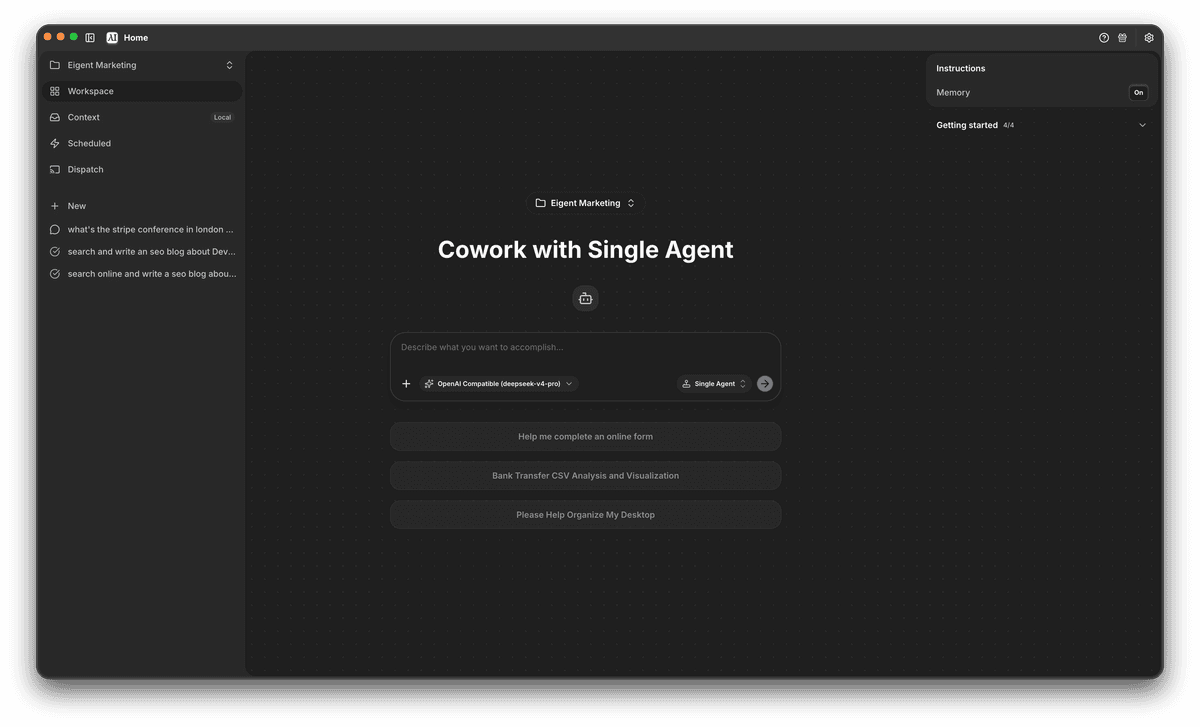
This means the real design problem is not only how to help one person become more productive.
The bigger question is:
How can a company safely configure, distribute, and manage agent capabilities for many employees?
That is where Eigent begins.
In Eigent, the primary configuration owner may be an enterprise administrator, an IT or security team, a department leader, an operations team, or an internal AI platform team.
They can define things like:
- which models are available
- which tools and MCP integrations can be used
- which files, apps, or connected resources are accessible
- how workspace instructions and memory should behave
- whether a task should use one agent or multiple specialist agents
- how scheduled or remote work should be executed
After this environment is prepared, employees do not need to build the whole agent system themselves. They enter an approved workspace and focus on the business outcome they want to achieve.
For example, instead of asking every employee to choose models, connect tools, write instructions, and manage permissions, a company can create a workspace for a specific department or workflow.
- A sales operations team may have one workspace
- A finance team may have another
- A customer support team may have another
Each workspace can have different permissions, tools, memory, and agent behavior.
The employee’s job becomes much simpler:
Choose the right workspace, describe the task, and review the result.
This is the key design difference.
Eigent is not a personal assistant that later adds enterprise features. It is a governed agent workspace designed for organizational deployment from the beginning.
The Core Difference: Who Prepares the Agent?
The easiest way to understand the difference is to ask:
Who prepares the agent for work?
For Codex, the answer is usually:
The user is both the operator and the administrator.
The individual chooses the project, tools, model, approval policy, and workflow.
For Claude Cowork, the answer is:
The user is the delegator and personal customizer.
The product hides much of the complexity and helps the user delegate work in a familiar way.
For Eigent, the answer is:
The organization is the administrator, and the employee is the operator.
The company prepares the approved environment. The employee uses that environment to get work done.
This single difference creates a very different product experience.
Codex optimizes for precision and control. Claude Cowork optimizes for accessibility and delegation. Eigent optimizes for governance, repeatability, and scalable deployment.
Why This Matters for Business Users
For individual users, freedom and flexibility are usually good things. The user can choose any project, any tool, any workflow, and adjust the agent based on personal preference.
But in a company, too much individual freedom can create new problems.
Different employees may use different models. They may connect different tools. They may create inconsistent workflows. They may expose sensitive data by mistake. They may build useful processes that cannot be repeated by others. They may rely on personal configurations that the organization cannot manage or audit.
This is why business AI agent design needs a different foundation.
In a company, trust does not only come from user approval. It also comes from policy, configuration, visibility, permissions, and auditability.
That is why Eigent puts governance into the foundation of the product rather than treating it as an expansion layer.
The goal is not to make every employee become an agent infrastructure expert. The goal is to let employees benefit from AI agents inside an environment that the organization can understand, manage, and scale.
Different Products, Different Design Questions
Codex mainly asks:
How can an agent help a power user execute projects more effectively?
Claude Cowork mainly asks:
How can an agent become an approachable digital coworker for an individual?
Eigent mainly asks:
How can an organization safely provide agent capabilities to its workforce?
These are all valid design questions. None of them is simply better than the others. They just lead to different products.
Codex is powerful when the user wants control. Claude Cowork is strong when the user wants approachable personal delegation. Eigent is designed for companies that need standardization, governance, and team-level deployment.
Eigent’s Design Philosophy
The design philosophy behind Eigent can be summarized in three principles.
Treat agents as organizational infrastructure
AI work needs to fit into departments, permissions, workflows, compliance rules, and shared systems.
Separate configuration from execution
Employees should complete tasks without first managing models, tools, memory policies, and agent teams.
Make successful work repeatable
A useful workflow should become a visible, governable standard that a team can reuse and improve.
This is why Eigent is built around centrally managed workspaces, configured capabilities, and organization-level control.
What This Changes
Codex gives technically confident individuals direct control, while Claude Cowork makes personal delegation approachable for a broader range of knowledge workers. Eigent begins one level higher: it asks how an organization can prepare trusted agent environments that employees can use without becoming agent infrastructure experts themselves. That shift from personal configuration to organizational preparation is the design thinking behind Eigent, and it is what makes governance, repeatability, permissions, and shared workspaces part of the product’s foundation rather than features added later.